Mold Air Testing Winnipeg – Indoor Air Quality & Airborne Mold Spore Testing
Are you concerned about mold spores circulating through your home? Perhaps you’ve noticed a persistent musty smell, experienced water damage, or discovered suspicious mold growth near your heating and ventilation system.
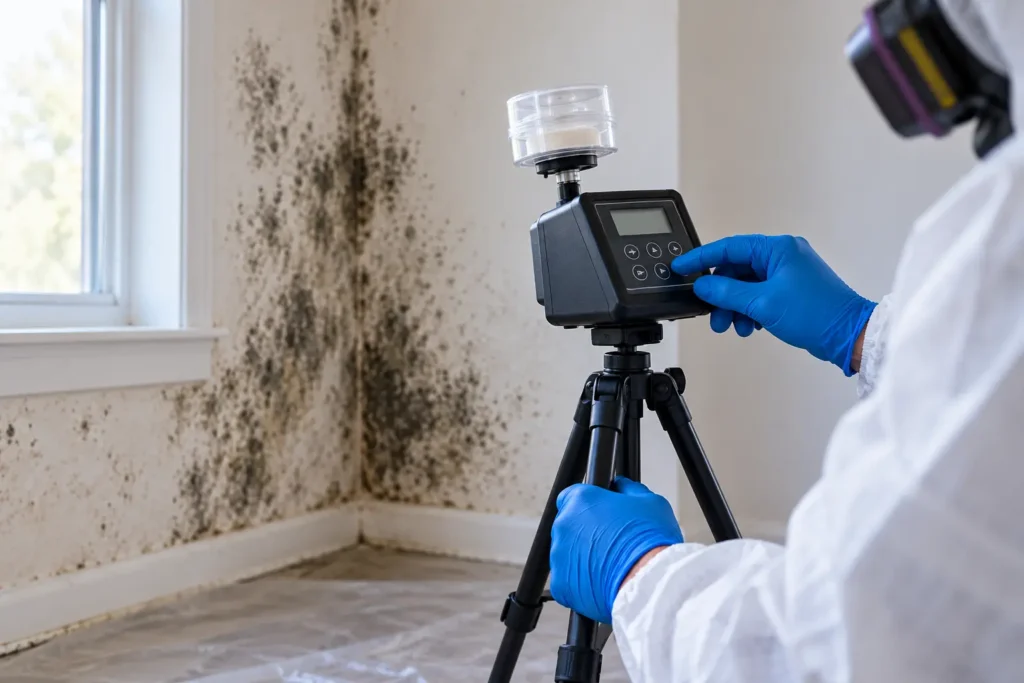
Mold air testing in Winnipeg involves collecting airborne particles for laboratory analysis to investigate specific mold-related indoor environmental concerns. Depending on the property, an assessment may include air sampling, moisture measurements, visual inspection, and evaluation of areas where mold growth is suspected.
Airborne mold particles occur naturally in indoor and outdoor environments. However, moisture problems inside a building can support additional mold growth on drywall, insulation, flooring, wood, and other susceptible materials.
Understanding the difference between normal background mold particles and a building-related moisture problem requires more than simply detecting mold in an air sample.
At Assured Builders, we help Winnipeg homeowners, landlords, property managers, and commercial property owners understand mold-related building damage and the restoration work that may be necessary.
Where specialized mold air sampling or laboratory testing is needed, an appropriately qualified environmental testing provider should determine the appropriate methods and interpret the findings.
Call Assured Builders at 431-293-0168 to discuss suspected mold damage, air quality concerns, and restoration options in Winnipeg.
What Is Mold Air Testing?
Mold air testing is a sampling method used to collect airborne fungal particles from a specific indoor or outdoor location.
The collected sample is analyzed using an appropriate laboratory method.
Results may provide information about the types or quantities of fungal particles collected during the sampling period.
However, an air test is only a snapshot of conditions at a particular time.
It does not automatically establish the full extent of contamination inside a building or identify every concealed mold problem.
What Can Mold Air Testing Help Investigate?
Depending on the circumstances, air sampling may be used to investigate:
Specific indoor environmental concerns
Suspected airborne fungal particles
Conditions identified during a mold inspection
Questions requiring laboratory analysis
Selected comparisons between indoor and outdoor samples
Defined assessment or documentation requirements
Testing should have a clear purpose.
A qualified assessor should explain why air sampling is being recommended and how the results will affect the next steps.
When Should You Consider Mold Air Testing in Winnipeg?
Not every property with visible mold requires air testing.
When contamination is already visible, identifying and correcting the moisture source is often more important than collecting airborne samples.
However, air sampling may be considered when a qualified environmental professional determines that the results could provide useful additional information.
Situations Where Air Testing May Be Considered
Persistent musty odours with no obvious source
A complex indoor environmental investigation
Specific concerns following water damage
An independent environmental assessment
Documentation requirements for a defined purpose
Questions about airborne fungal particles
An assessment involving several potentially affected areas
Air testing should not be used as a substitute for investigating leaks, condensation, damp insulation, or water-damaged drywall.
How Does Professional Mold Air Testing Work?
Professional air sampling follows a defined process based on the assessment objectives.
Step 1: Initial Property Assessment
The assessor reviews the property’s history and examines accessible areas for moisture-related problems.
This may include evaluating previous flooding, plumbing leaks, roof damage, condensation, and visible contamination.
Step 2: Selecting Sampling Locations
Sampling locations are selected according to the purpose of the investigation.
Depending on the assessment, samples may be collected from specific rooms and outdoor locations.
Step 3: Collecting Air Samples
A calibrated sampling device may draw a measured volume of air through a collection medium.
The method and sampling duration depend on the selected protocol.
Step 4: Laboratory Analysis
Samples are submitted for analysis using the appropriate laboratory method.
Step 5: Interpreting the Results
The findings should be interpreted alongside the building’s moisture conditions, visual observations, sampling limitations, and other relevant information.
Step 6: Recommendations
If the assessment identifies moisture problems or contamination requiring attention, recommendations may include further investigation, repairs, or remediation.
Mold Spore Testing Winnipeg
Mold spore testing is commonly associated with airborne mold assessments.
Mold spores are microscopic reproductive structures that can become airborne and travel through indoor and outdoor environments.
Are Mold Spores Normally Present Indoors?
Yes.
Mold spores naturally occur in outdoor air and can enter buildings through doors, windows, ventilation systems, and other openings.
Detecting mold spores indoors does not automatically indicate an abnormal contamination problem.
What Does a Mold Spore Test Measure?
Depending on the laboratory method, results may describe the fungal particles identified in the sample.
Some methods provide estimates of particle concentrations, while others identify particular fungal groups.
Results should be interpreted carefully because sampling methods have limitations.
Can a Mold Spore Test Determine Whether a House Is Safe?
No single mold spore test can guarantee that a property is completely safe or free of mold.
There is no universally accepted numerical airborne mold concentration that reliably distinguishes safe from unsafe conditions in every indoor environment.
The building’s moisture conditions and visible contamination remain important.
Indoor Air Quality Testing for Mold Winnipeg
Indoor air quality testing is a broader category of environmental assessment.
Mold air sampling may be one part of an indoor air quality investigation, but it does not measure every potential indoor contaminant.
Indoor air quality can also be affected by ventilation, humidity, combustion products, particulate matter, and other pollutants.
Mold Testing vs. General Air Quality Testing
| Mold Air Testing | General Indoor Air Quality Testing |
|---|---|
| Focuses on selected fungal particles | May evaluate multiple indoor pollutants |
| May involve laboratory spore analysis | May involve sensors and specialized sampling |
| Used for specific mold-related questions | Used for broader indoor environmental concerns |
| Does not identify every hidden mold source | Does not necessarily include mold sampling |
| Requires interpretation within building conditions | Requires interpretation based on pollutants measured |
If your concern involves mold, ask whether the proposed indoor air quality assessment actually includes fungal sampling and moisture investigation.
Air Quality Test for Black Mold
Homeowners often request an air quality test for black mold after discovering dark staining or experiencing a persistent musty smell.
However, mold colour alone cannot reliably identify the species.
Many types of mold can appear black, grey, or dark green.
Can Air Testing Detect Black Mold?
Certain sampling and laboratory methods may identify fungal particles associated with particular groups or species.
However, airborne sampling may not reliably detect mold growing on a concealed surface.
Some mold species are also less likely to be represented in particular air samples.
Does a Negative Air Test Mean There Is No Black Mold?
No.
A sample that does not identify a particular mold does not prove that the organism is absent from every wall, ceiling, attic, or other building material.
A thorough investigation should consider visible contamination and moisture conditions.
Is Black Mold Air Testing Always Necessary?
Not always.
When visible mold and water-damaged materials are present, appropriate remediation may be required regardless of the species identified.
Mold Air Testing for Homes
Residential mold air testing may be considered when homeowners require additional information during an environmental assessment.
The appropriate approach depends on the building’s size, layout, history of moisture damage, and specific concerns.
Common Areas Evaluated
Basements
Bedrooms
Living rooms
Bathrooms
Kitchens
Attics
Finished lower levels
Areas affected by previous flooding
An assessor may focus on particular rooms rather than automatically collecting samples throughout the entire house.
Should Every Room Be Tested?
Not necessarily.
Sampling every room can increase costs without always providing information that changes the corrective action.
The sampling plan should be based on the purpose of the investigation.
Basement Mold Air Testing Winnipeg
Basements are common locations for moisture-related mold problems.
Foundation seepage, flooding, plumbing leaks, and condensation can affect drywall, insulation, flooring, and other materials.
When Is Basement Air Testing Considered?
Air sampling may be considered as part of a broader assessment when there are specific unanswered questions.
However, a musty basement often requires moisture investigation regardless of air test results.
Signs of Basement Moisture Problems
Damp foundation walls
Water stains
Musty odours
Swollen drywall
Mold behind baseboards
Previous flooding
Wet insulation
Moisture beneath flooring
If contamination is visible, remediation planning and moisture correction may be more useful than routine air testing.
Mold Air Testing After Water Damage
Water damage can create conditions favourable to mold growth when affected materials remain damp.
Common sources include:
Burst pipes
Basement flooding
Roof leaks
Appliance failures
Plumbing leaks
Window leaks
Foundation seepage
Is Air Testing Necessary After Flooding?
Not automatically.
The immediate priority after water damage is safety, stopping the water source, and arranging prompt drying or removal of affected materials.
If visible mold or significant material damage has developed, appropriate remediation may be required.
Air sampling should be considered only when it will answer a specific question relevant to the assessment.
HVAC Mold Inspection Winnipeg
Heating, ventilation, and air-conditioning systems can develop moisture problems under certain conditions.
However, dark deposits around vents do not automatically indicate mold.
Signs of Possible HVAC Moisture Problems
Potential concerns include:
Persistent dampness inside equipment
Condensate drainage problems
Wet internal insulation
Moisture-damaged duct materials
Water accumulation near cooling components
Visible growth on accessible components
Can Mold Air Testing Identify HVAC Contamination?
Air sampling alone cannot reliably establish the condition of every internal HVAC component.
A qualified HVAC professional or environmental assessor may need to inspect the equipment directly.
Should You Clean Air Ducts If Mold Is Suspected?
The appropriate action depends on whether contamination is actually present and what materials are affected.
Cleaning ducts without correcting the source of moisture may not resolve the problem.
Mold Air Testing for Apartments and Rental Properties
Tenants may become concerned about indoor mold after discovering recurring condensation, musty odours, or water damage.
Common apartment moisture problems include:
Bathroom condensation
Mold around windows
Plumbing leaks
Water damage from neighbouring units
Damp exterior walls
Kitchen cabinet leaks
Should Tenants Arrange Air Testing?
Tenants should document concerns and notify their landlord or property manager.
A professional assessment may be appropriate when moisture or contamination concerns remain unresolved.
However, air sampling is not always necessary when visible mold and water damage are already present.
In Manitoba, maintenance and repair concerns involving rental properties may be addressed through applicable residential tenancy processes.
Commercial Mold Air Testing Winnipeg
Commercial properties may require environmental assessment when moisture problems affect occupied spaces, building materials, or business operations.
Potentially affected properties include:
Offices
Retail stores
Warehouses
Rental buildings
Commercial kitchens
Multi-unit properties
A commercial investigation may require additional documentation, sampling locations, and coordination with property management.
Larger projects may benefit from an independent environmental consultant.
Mold Detector for Home: Can You Measure Mold in the Air?
Many homeowners search for a mold detector that can instantly measure airborne mold.
However, most consumer indoor air quality monitors cannot identify specific mold spores or determine whether a building has a mold contamination problem.
Air Quality Monitors
Some devices measure:
Relative humidity
Temperature
Particulate matter
Carbon dioxide
Selected volatile organic compounds
These measurements may provide useful information about indoor environmental conditions, but they do not directly identify mold species.
Moisture Meters
Moisture meters can help identify damp building materials.
They do not measure airborne mold.
Thermal Imaging Cameras
Thermal cameras may reveal temperature differences associated with moisture or insulation problems.
They cannot directly detect mold.
Professional Air Sampling Equipment
Specialized sampling equipment can collect airborne particles for laboratory analysis.
The resulting data still requires appropriate interpretation.
Are Home Mold Air Test Kits Reliable?
DIY mold testing kits are available from hardware stores and online retailers.
Some kits use culture plates, while others require collected samples to be sent to a laboratory.
Limitations of Home Mold Tests
DIY kits may not determine:
The source of moisture
Whether contamination is abnormal
The extent of hidden mold
Whether remediation is necessary
The condition of building materials
The appropriate corrective action
Because mold spores naturally occur in indoor and outdoor air, a positive result does not automatically establish a serious building problem.
Are Home Depot Mold Detectors Effective?
The usefulness of a product depends on what it actually measures.
A humidity meter or particulate monitor cannot identify black mold species.
A culture-based test may detect some viable fungi under the test conditions but does not provide a complete assessment of the property.
For significant moisture problems, professional building assessment is generally more informative than relying solely on a home test kit.
Mold Air Testing Cost Winnipeg
One of the most common questions homeowners ask is: How much does mold air testing cost in Winnipeg?
Prices vary depending on the number of samples, laboratory analysis, inspection time, reporting requirements, and complexity of the investigation.
The following figures are broad Canadian-dollar budgeting estimates, not verified Winnipeg market averages or confirmed Assured Builders pricing.
| Mold Air Testing Service | Estimated Cost (CAD) |
|---|---|
| Basic mold and moisture inspection | $150–$300 |
| Limited air sampling appointment | $250–$500 |
| Multiple-room air sampling | $400–$800 |
| Air sampling with detailed written assessment | $500–$1,000+ |
| Complex residential environmental investigation | $800–$1,500+ |
| Large commercial mold air quality assessment | $1,000–$2,500+ |
Actual costs may fall outside these ranges.
What Affects Mold Air Testing Prices?
Number of samples: Additional samples increase laboratory analysis costs.
Property size: Larger buildings may require more inspection time.
Sampling methods: Different methods involve different equipment and laboratory requirements.
Reporting: Detailed documentation may increase the cost.
Accessibility: Difficult-to-reach areas may require additional investigation.
Assessment complexity: Multiple moisture problems can increase the scope of work.
Ask whether laboratory fees, outdoor comparison samples, and written interpretation are included in the quoted price.
How Long Does Mold Air Testing Take?
A limited air sampling appointment may take less than an hour, although the full inspection may require additional time.
Larger properties or investigations involving several sampling locations can take longer.
Laboratory analysis may require additional business days, depending on the provider and method used.
The testing company should explain the expected timeline before the appointment.
How to Prepare for a Mold Air Quality Test
Preparation instructions depend on the sampling method and purpose of the assessment.
The testing provider may give specific directions regarding:
Windows and doors
Ventilation systems
Cleaning activities
Air purifiers
Room access
Occupancy and activity
Recent water damage
Do not change normal building conditions or attempt to influence test results without instructions from the assessor.
Accurate documentation of the conditions during sampling is important.
How to Choose a Mold Air Testing Company in Winnipeg
When comparing mold air testing companies, consider qualifications, assessment methods, and the quality of reporting.
Questions to Ask
What relevant training and experience do you have?
Why is air sampling recommended?
Will you inspect for moisture problems?
How many samples are included?
Are outdoor comparison samples appropriate?
Which laboratory methods will be used?
Are laboratory fees included?
Will I receive a written report?
How will the results be interpreted?
What are the limitations of the testing method?
Is the assessment independent of remediation work?
A qualified assessor should be able to explain how the proposed testing will help answer a specific question.
What Happens if Mold Is Found in the Air?
Detecting mold particles in an air sample does not automatically mean a property requires extensive remediation.
The findings should be evaluated alongside visible contamination, moisture conditions, and other inspection observations.
No Significant Building Moisture Problem Identified
The assessor may recommend routine maintenance or further investigation if concerns remain unresolved.
Localized Surface Mold
Appropriate cleaning and moisture correction may be sufficient for minor contamination on suitable surfaces.
Extensive or Concealed Mold
Additional investigation or specialized remediation may be necessary.
Water-Damaged Building Materials
Restoration may involve removing damaged drywall, replacing insulation, repairing flooring, and reconstructing affected areas.
The objective is to address the underlying building conditions rather than focus solely on an airborne mold measurement.
Mold Air Testing vs. Mold Remediation
Mold air testing and mold remediation serve different purposes.
Mold air testing collects airborne particles for laboratory analysis.
Mold inspection evaluates moisture conditions, visible contamination, and building defects.
Mold remediation addresses contamination through appropriate cleaning, removal, and moisture control.
Mold damage restoration repairs and replaces affected building materials after necessary remediation work.
A property may require one or more of these services depending on the circumstances.
Why Mold Air Quality Concerns Occur in Winnipeg Homes
Winnipeg’s seasonal climate can contribute to several moisture-related building problems.
Winter Condensation
Cold outdoor temperatures can contribute to condensation on poorly insulated or inadequately sealed surfaces.
Spring Snowmelt
Melting snow and changing groundwater conditions may contribute to basement seepage.
Heavy Rainfall
Water intrusion through roofs, foundations, and windows can damage building materials.
Plumbing Leaks
Concealed leaks can introduce moisture into drywall, insulation, and flooring.
Ventilation Problems
Inadequate ventilation may contribute to persistent dampness in bathrooms, attics, and other enclosed spaces.
Understanding these conditions is essential to determining whether mold investigation or restoration is necessary.
Why Contact Assured Builders About Mold Air Testing and Restoration?
Mold-related indoor air quality concerns can sometimes be associated with moisture-damaged building materials.
Assured Builders helps Winnipeg homeowners, landlords, and commercial property owners understand mold-related restoration needs and plan appropriate repairs.
Depending on the property, restoration may involve:
Drywall replacement
Insulation repairs
Ceiling restoration
Flooring replacement
Cabinet repairs
Interior reconstruction
Moisture-related building repairs
Where professional mold air sampling, laboratory analysis, or independent environmental assessment is necessary, an appropriately qualified testing provider should establish the sampling and interpretation requirements.
Where specialized mold remediation is required, the appropriate work should be completed before reconstruction begins.
Our focus is on helping property owners address damaged materials and the moisture conditions contributing to mold problems.
Frequently Asked Questions About Mold Air Testing Winnipeg
What is mold air testing?
Mold air testing involves collecting airborne fungal particles for laboratory analysis. Results provide information about the sample collected under specific conditions.
How much does mold air testing cost in Winnipeg?
Limited air testing may cost a few hundred dollars, while comprehensive assessments involving multiple samples and detailed reporting can cost considerably more. Actual prices depend on the provider and scope.
Can air quality testing detect mold?
Certain air sampling methods can collect fungal particles for analysis. However, general consumer air quality monitors typically cannot identify mold species.
Can mold air testing detect black mold?
Some sampling methods may identify particular fungal groups, but air testing alone cannot reliably determine whether black mold is present on every concealed surface.
Is mold air testing accurate?
Results can provide useful information for a defined sampling objective, but they are influenced by environmental conditions and have limitations.
Can a negative mold air test rule out mold?
No. A negative or unremarkable air sample does not prove that concealed mold is absent.
Should I test every room for mold?
Not necessarily. Sampling locations should be selected based on the purpose of the investigation rather than automatically testing every room.
Are mold spores always present in indoor air?
Mold spores commonly occur in indoor and outdoor environments. Their presence alone does not establish an abnormal building condition.
Can a home mold detector measure mold spores?
Most consumer air quality monitors cannot specifically identify mold spores or determine mold species.
Does an HVAC inspection include mold air testing?
Not necessarily. HVAC inspection and mold air sampling are separate services, although they may be combined when appropriate.
Can I perform a mold air test myself?
DIY kits are available, but they have limitations and do not replace a comprehensive moisture and building assessment.
How long does mold air testing take?
A limited sampling appointment may take less than an hour, while larger investigations can take several hours. Laboratory results may require additional time.
Is mold air testing necessary before remediation?
Not always. Visible mold and moisture damage may justify appropriate remediation without laboratory air testing.
Can mold return after remediation?
Yes. Mold can develop again if moisture problems remain unresolved or new water intrusion occurs.
Discuss Mold Air Testing and Restoration in Winnipeg
If you’re concerned about airborne mold, persistent musty odours, water-damaged drywall, or possible concealed contamination, understanding the property’s moisture conditions is an important first step.
Assured Builders helps Winnipeg homeowners, landlords, and property managers evaluate mold-related building damage and plan appropriate restoration work.
Whether your property requires professional mold air testing, an indoor environmental assessment, remediation planning, or repairs following moisture damage, our team can help you discuss the next steps.
Assured Builders – Mold Air Testing & Restoration Information Winnipeg
Phone: 431-293-0168
Call today to discuss your mold concerns, confirm available services, and request information about assessment and restoration options.