Attic Mold Removal Winnipeg – Professional Mold Remediation & Restoration
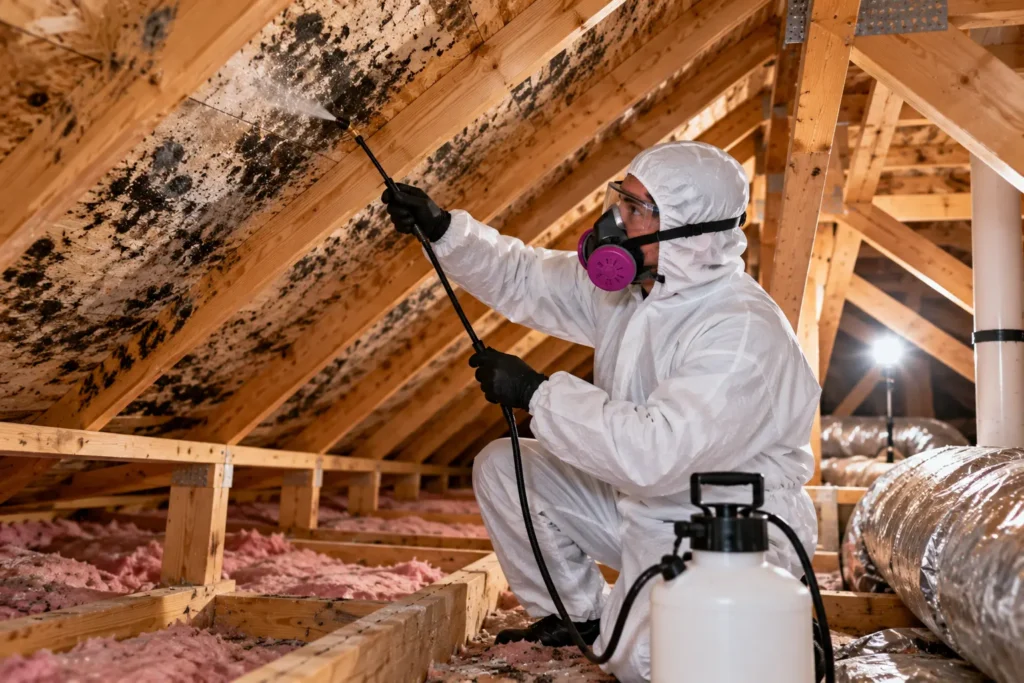
Discovering mold in your attic can be concerning, especially when dark stains, white patches, or musty odours appear on roof sheathing, wooden rafters, or insulation. Attic mold is a common moisture-related problem in Winnipeg homes, particularly during colder months when warm indoor air can enter freezing attic spaces and create condensation.
Assured Builders provides attic mold removal and restoration solutions in Winnipeg, helping homeowners address mold-affected building materials, moisture damage, and the underlying conditions that contribute to attic contamination.
Whether you’re dealing with black mold on attic plywood, white mold on wooden framing, or widespread contamination following a roof leak, addressing the problem early can help prevent further deterioration.
Effective attic mold remediation involves more than cleaning visible stains. It requires identifying the moisture source, evaluating affected materials, selecting appropriate remediation methods, and correcting conditions that could allow mold to return.
If you’ve discovered mold in your attic, call Assured Builders at 431-293-0168 to discuss your property and request an assessment.
What Causes Mold in Attics?
Mold develops when moisture remains on susceptible building materials long enough to support microbial growth.
In Winnipeg, attic mold is frequently associated with condensation, ventilation problems, roof leaks, and warm indoor air escaping into cold roof cavities.
During winter, heated indoor air naturally tends to move upward. If gaps exist around attic hatches, plumbing penetrations, light fixtures, or other ceiling openings, warm, humid air can enter the attic.
When this moisture reaches cold roof sheathing, it may condense or freeze. Repeated wetting can eventually create conditions favourable to mold growth.
Common Causes of Attic Mold
Several building conditions can contribute to mold development:
Inadequate attic ventilation
Air leakage from heated living spaces
Bathroom exhaust fans venting into the attic
Blocked soffit vents
Roof leaks and damaged flashing
Poorly sealed attic access hatches
Excessive indoor humidity
Condensation on roof sheathing
Wet or improperly installed insulation
Identifying the cause is essential because cleaning mold without correcting moisture problems may allow contamination to return.
Signs You Need Attic Mold Removal
Attic mold is not always obvious from inside the home. Many homeowners discover contamination during a roof inspection, insulation upgrade, renovation, or real estate transaction.
Common warning signs include:
Black or dark staining on attic plywood
White or grey patches on wooden framing
Musty odours near the attic entrance
Damp or deteriorating roof sheathing
Frost accumulation inside the attic during winter
Water stains around roof penetrations
Wet or compressed insulation
Visible condensation on structural components
Some staining may be unrelated to active mold growth, so an appropriate inspection is important before deciding on treatment.
If mold is suspected, avoid disturbing contaminated materials unnecessarily.
Professional Attic Mold Remediation Winnipeg
Attic mold remediation involves evaluating contamination, removing or cleaning affected materials where appropriate, and addressing the moisture conditions responsible for the problem.
Unlike ordinary household cleaning, attic remediation can involve difficult access, exposed insulation, electrical hazards, and work around roof framing.
A professional attic mold removal service should consider both the visible contamination and the building conditions that caused it.
Attic Mold Inspection
The first step is evaluating the attic’s condition.
An inspection may include examining:
Roof sheathing and plywood
Rafters and trusses
Insulation and vapour-control details
Ventilation openings
Bathroom and kitchen exhaust ducts
Roof penetrations and flashing
Attic access points
Signs of condensation or water intrusion
The assessment helps determine whether the problem is caused by condensation, a roof leak, or another moisture source.
Attic Mold Mitigation
Attic mold mitigation focuses on reducing moisture and preventing additional contamination.
Depending on the building, corrective measures may include sealing air leaks, repairing roof defects, improving ventilation, correcting exhaust duct connections, or addressing excessive indoor humidity.
Attic Mold Cleanup
The cleaning method depends on the extent of contamination and the condition of affected materials.
Appropriate remediation may involve specialized cleaning of salvageable wood surfaces, controlled removal of contaminated debris, or replacement of materials that cannot be adequately restored.
Containment and dust-control measures may be necessary to reduce the movement of contaminated particles into occupied areas.
Attic Mold Repair and Restoration
If mold or prolonged moisture exposure has damaged plywood, insulation, or other building components, additional repairs may be required.
Restoration work may include replacing deteriorated roof sheathing, correcting insulation problems, repairing ventilation components, and addressing water-damaged construction materials.
Removing Mold From Attic Plywood
One of the most common attic mold problems involves contamination on plywood or oriented strand board (OSB) roof sheathing.
These wood-based materials can support mold growth when exposed to repeated condensation or roof leaks.
Black staining on attic plywood is often discovered near roof slopes, ventilation openings, or areas where warm indoor air escapes into the attic.
Can Moldy Attic Plywood Be Cleaned?
In some situations, structurally sound plywood with surface contamination can be cleaned using appropriate remediation methods.
However, the condition of the wood must be evaluated before treatment.
Plywood that has deteriorated because of prolonged water exposure, delamination, or structural damage may require replacement.
Simply painting over mold or applying a chemical treatment without correcting the moisture source is not a reliable long-term solution.
When Does Attic Plywood Need Replacement?
Replacement may be necessary when:
The plywood has softened or deteriorated
Layers are separating
Water damage has compromised structural performance
Contamination cannot be adequately addressed
Roof repairs require removal of affected sheathing
Assured Builders can help homeowners discuss restoration requirements when attic mold is associated with damaged building materials.
Black Mold in Attic – What Homeowners Should Know
Black mold in attics is a common concern among Winnipeg homeowners.
Dark-coloured growth may appear on plywood, rafters, roof sheathing, and other wooden surfaces.
However, mold colour alone cannot identify the species or determine its potential health effects.
The term black mold is often associated with Stachybotrys chartarum, but many other mold species can appear dark or black.
Is Black Mold in the Attic Dangerous?
Exposure to damp and moldy environments may contribute to respiratory symptoms, allergies, or asthma-related problems in susceptible individuals.
The potential risk depends on several factors, including exposure conditions and individual sensitivity.
Visible mold should be addressed appropriately regardless of its colour.
Black Mold in Attic Removal
Professional black mold remediation may involve evaluating the affected area, correcting moisture sources, cleaning salvageable materials, and removing severely damaged components.
The appropriate treatment depends on the extent of contamination and the condition of the attic structure.
White Mold in Attic Removal
White or light-coloured mold can develop on wooden framing, plywood, and other attic materials exposed to moisture.
White mold on wood in an attic may appear powdery, fuzzy, or patchy.
However, not every white deposit is mold. Some deposits may be dust, mineral residue, or another material.
An inspection can help determine the nature of the problem and whether remediation is required.
White Mold Removal Cost
The cost of white mold removal depends on the size of the affected area, accessibility, material condition, and required moisture corrections.
White mold is not automatically cheaper or easier to remove than dark-coloured mold.
The remediation approach should be based on the extent of contamination rather than appearance alone.
Attic Mold Removal Cost in Winnipeg
One of the most common questions homeowners ask is: How much does attic mold removal cost in Winnipeg?
Attic mold remediation cost depends on the size of the affected area, roof configuration, contamination severity, accessibility, and the condition of roof sheathing and insulation.
The following amounts are broad budgeting estimates in Canadian dollars. They are not verified local averages or fixed Assured Builders quotations.
| Attic Mold Removal Project | Estimated Cost (CAD) |
|---|---|
| Small, localized attic mold remediation | $500–$1,500 |
| Moderate attic mold removal | $1,500–$3,000 |
| Larger attic mold remediation project | $3,000–$5,000+ |
| Extensive contamination and material removal | $5,000–$8,000+ |
| Severe damage requiring major roof or attic restoration | $8,000–$15,000+ |
Actual costs can fall outside these ranges.
Factors Affecting Attic Mold Remediation Cost
Size of the affected area: Larger contaminated surfaces generally require more labour and materials.
Attic accessibility: Low-clearance spaces, steep roof slopes, and restricted access can make remediation more difficult.
Condition of roof sheathing: Damaged plywood or OSB may require replacement rather than cleaning.
Insulation contamination: Wet or contaminated insulation may need removal and replacement.
Moisture correction: Ventilation improvements, air sealing, roof repairs, or exhaust duct corrections can increase the overall project cost.
Containment requirements: Some projects require additional protective measures to limit contamination during cleanup.
The average cost to remove mold from an attic is therefore best established through a property-specific assessment.
Roof Leak Mold Remediation Cost
Roof leaks can cause localized or widespread attic moisture damage.
Water may enter through damaged shingles, flashing, roof penetrations, or deteriorated roofing components.
Over time, repeated leakage can affect roof sheathing, insulation, rafters, and ceiling materials.
Roof leak mold remediation cost may include both contamination removal and repairs to the roofing system.
For example, replacing damaged plywood or correcting flashing problems can increase the total cost beyond the mold cleanup itself.
Addressing the roof leak is essential before completing interior or attic restoration.
Why Attic Mold Is Common During Winnipeg Winters
Winnipeg’s long, cold winters create substantial temperature differences between heated living spaces and unheated attics.
When warm indoor air escapes through ceiling openings, moisture can condense or freeze on cold roof surfaces.
Frost accumulation may remain unnoticed until temperatures rise.
During warmer periods, accumulated frost can melt and wet roof sheathing or insulation.
Repeated moisture exposure can contribute to mold development.
Common Winter Attic Problems
Winnipeg homeowners may encounter:
Frost on roof nails and sheathing
Condensation around attic penetrations
Wet insulation near ceiling openings
Mold staining on plywood
Blocked soffit ventilation
Bathroom exhaust moisture entering the attic
These problems often require attention to air sealing, moisture control, and ventilation rather than cleaning alone.
Attic Ventilation and Mold Prevention
Proper attic ventilation helps manage moisture and temperature conditions, but ventilation alone may not resolve every attic mold problem.
Warm indoor air leaking into the attic can introduce substantial moisture, even when ventilation openings are present.
A complete attic moisture assessment should consider the building’s air barrier, insulation, exhaust ducts, and roof ventilation system.
Soffit Ventilation
Soffit vents allow outdoor air to enter certain attic ventilation systems.
Blocked soffit vents can restrict airflow and contribute to moisture accumulation.
Roof Ventilation
Ridge vents, roof vents, or other appropriately designed ventilation components can help move air through the attic.
Ventilation design should match the roof configuration and applicable building requirements.
Air Sealing
Sealing gaps around attic hatches, plumbing penetrations, wiring openings, and other ceiling penetrations can reduce the movement of warm, humid indoor air into the attic.
Bathroom Exhaust Ventilation
Bathroom exhaust fans should discharge outdoors through appropriately installed ducts rather than releasing humid air into the attic.
Correcting improperly terminated exhaust ducts can help prevent recurring moisture problems.
Attic Mold Treatment vs. Complete Remediation
Some homeowners search for an attic mold killer or chemical treatment that can eliminate contamination quickly.
However, spraying a chemical product onto visible mold is not equivalent to complete remediation.
Mold treatment may form part of an appropriate cleaning procedure, but it does not automatically remove contaminated material or resolve the conditions responsible for growth.
Effective remediation considers:
The moisture source
The extent of contamination
The condition of affected materials
Suitable cleaning or removal methods
Dust and debris control
Required repairs
Measures to prevent recurrence
A surface that looks clean after treatment may still require further attention if moisture or contamination remains.
Can You Remove Attic Mold Yourself?
Small amounts of mold on accessible, suitable surfaces may sometimes be addressed by homeowners using appropriate precautions.
However, attic remediation presents additional challenges compared with cleaning ordinary household surfaces.
Attics may contain exposed wiring, limited walking surfaces, loose-fill insulation, and structural components that are not designed to support foot traffic.
Disturbing contaminated materials can also release dust and particles.
Professional assessment is advisable when contamination is extensive, concealed, associated with damaged insulation, or located in difficult-to-access areas.
Avoid walking directly on ceiling drywall or disturbing suspect materials without understanding the hazards involved.
Does Homeowners Insurance Cover Attic Mold Removal?
Insurance coverage depends on the cause of the damage and the terms of the policy.
Some sudden and accidental water damage events may qualify for coverage, while long-term condensation, inadequate maintenance, or gradual deterioration may be excluded.
Homeowners should contact their insurance provider to confirm whether the policy covers mold remediation, roof repairs, and restoration of damaged building materials.
Documentation of the damage and its suspected cause may be helpful when discussing a claim.
Attic Mold During a Home Inspection
Attic mold is sometimes discovered when buying or selling a home in Winnipeg.
Visible staining on roof sheathing can raise concerns about moisture intrusion, ventilation, and the condition of building materials.
A home inspector may identify suspicious staining or moisture-related defects, but additional assessment may be necessary to determine the extent of contamination and appropriate corrective work.
Should Attic Mold Be Removed Before Selling a House?
Addressing known moisture problems and contamination can help provide clarity about the condition of the property.
However, cleaning visible mold without correcting the underlying problem may leave future buyers with unresolved concerns.
A documented assessment and appropriate repairs can help explain what was found and what corrective measures were completed.
How to Prevent Attic Mold From Returning
Long-term attic mold prevention focuses on controlling moisture.
Homeowners can reduce the likelihood of recurring problems by:
Repairing roof leaks promptly
Keeping soffit vents unobstructed
Ensuring exhaust fans discharge outdoors
Sealing attic air leaks
Maintaining appropriate indoor humidity
Inspecting insulation for moisture damage
Addressing recurring winter frost
Investigating unusual ceiling stains
Regular roof and attic inspections can help identify moisture problems before extensive damage develops.
Why Choose Assured Builders for Attic Mold Restoration in Winnipeg?
Attic mold problems often involve multiple building components, including roof sheathing, insulation, ventilation, and moisture-damaged framing.
Addressing contamination without understanding the condition of these materials can result in incomplete repairs.
Assured Builders helps Winnipeg homeowners evaluate attic restoration needs and plan repairs associated with mold and moisture damage.
Depending on the condition of the property, work may involve roof sheathing repairs, insulation replacement, ventilation corrections, or other construction-related restoration.
Where specialized environmental assessment or remediation is required, the appropriate scope should be established before reconstruction begins.
Our focus is on practical solutions that address damaged building materials and the underlying conditions contributing to the problem.
Frequently Asked Questions About Attic Mold Removal
How much does attic mold removal cost in Winnipeg?
Small localized projects may cost approximately $500–$1,500, while moderate or extensive remediation can cost several thousand dollars. Major roof repairs or reconstruction can increase the total substantially. These are illustrative estimates, not verified Winnipeg averages.
Is black mold in the attic dangerous?
Mold exposure can affect susceptible individuals, particularly those with allergies, asthma, or respiratory sensitivities. Mold colour alone does not establish the species or health risk.
Can mold be removed from attic plywood?
In some cases, structurally sound plywood with surface contamination can be cleaned using appropriate remediation methods. Severely deteriorated or damaged plywood may require replacement.
What causes white mold on attic wood?
White or light-coloured mold may develop when moisture accumulates on wood surfaces. Condensation, roof leaks, and inadequate moisture control are possible contributing factors.
How long does attic mold remediation take?
Small projects may take one or two working days. Larger projects involving extensive cleaning, insulation removal, moisture correction, and reconstruction may take several days or longer.
Does attic mold mean I need a new roof?
Not necessarily. Attic mold can result from condensation and air leakage rather than a roof leak. Roof replacement is only appropriate when the roofing system’s condition warrants it.
Can attic mold spread into living areas?
Contaminated dust or particles can potentially move between building spaces through openings or air movement. Proper remediation procedures help reduce the risk of spreading contamination during work.
Is attic mold testing necessary?
Not always. Visible mold and known moisture damage can often be evaluated without laboratory identification. Testing may be appropriate when it serves a specific assessment purpose.
Can attic mold return after cleaning?
Yes. Mold may return if roof leaks, air leakage, condensation, or other moisture sources remain unresolved.
Should I replace attic insulation after mold removal?
Insulation replacement depends on its condition. Wet, contaminated, or deteriorated insulation may require removal, while unaffected insulation may be retained.
Request Attic Mold Removal in Winnipeg
If you’ve noticed black mold on attic plywood, white staining on wooden framing, persistent moisture, or signs of roof-related water damage, addressing the issue early can help prevent further deterioration.
Assured Builders provides attic mold-related restoration solutions in Winnipeg, helping homeowners understand the condition of affected building materials and plan appropriate repairs.
Whether your attic requires an inspection, moisture correction, mold remediation planning, or reconstruction following contamination removal, our team can help you discuss the next steps.
Assured Builders – Attic Mold Removal Winnipeg
Phone: 431-293-0168
Call today to request an assessment and discuss your attic mold removal and restoration needs.